Sleep Calculator Guide: Sleep Cycles, Bedtime and Wake-Up Times
Use a sleep calculator and sleep cycle calculator for bedtime and wake-up planning, with clear limits around 90-minute cycles, REM estimates and nap timing.
Sleep Calculator
Estimate practical bedtime and wake-up windows without treating sleep like an exact stopwatch.
Open Sleep Calculator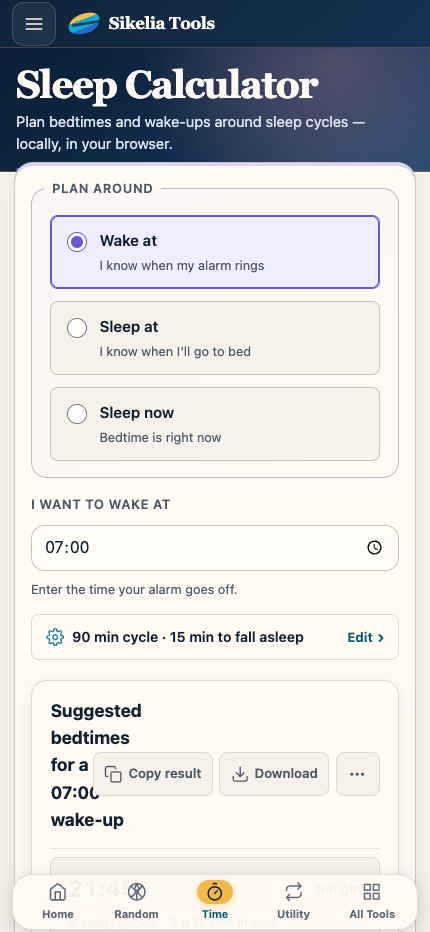
A sleep calculator can turn “I need to be up at 7” into a few possible bedtime windows. That is useful for planning, but it should not be treated as a promise that your body will follow an exact clock.
Sleep cycles vary from person to person and from night to night. The most useful way to use a calculator is as a schedule helper, not as a reason to sleep less.
Start with the time you actually need to wake up
If your morning schedule is fixed, enter the wake-up time first.
The calculator will show possible bedtime windows based on estimated sleep cycles. Look at those options and choose one that gives you enough total time in bed and fits your evening realistically.
Do not automatically choose the latest option just because it is still listed. A later bedtime can mean less total sleep, even if it happens to line up neatly with an estimated cycle.
Allow time to fall asleep
Getting into bed and falling asleep are not the same thing.
If you usually need time to wind down, include that when planning. A suggested sleep time of 11:00 PM may mean getting into bed earlier so you are actually ready to sleep around that time.
A regular routine can make this easier: lower the lights, finish the things you need to do, and give yourself a transition instead of treating bedtime as an instant switch.
Treat cycle times as estimates
Sleep calculators often use a simplified cycle model because it makes planning understandable. Real sleep does not run on one exact number for everyone.
The National Heart, Lung, and Blood Institute explains that people move through repeating stages of sleep and that cycle length can vary. That is why a calculator should give you useful windows rather than a magical perfect minute.
What about a REM sleep calculator, wake-up time calculator or nap calculator?
A sleep calculator can estimate clock times from an assumed cycle length, but it cannot measure your actual REM sleep. If you use the tool as a wake-up time calculator, enter the bedtime or “sleep now” starting point and compare the suggested times with your real schedule.
For a short nap, the same arithmetic can provide a planning reference, but naps do not always follow complete sleep cycles. Treat any “nap calculator” result as a time-planning estimate rather than a prediction of your sleep stages.
Total sleep still matters
A calculator should never become a tool for squeezing a short night into a mathematically tidy schedule.
If one suggested bedtime gives you much more sleep than another and both are realistic, the earlier option is usually the more sensible starting point.
For teenagers especially, sleep needs can be different from adult schedules, and consistently getting enough sleep is important. If sleep problems continue or you are regularly exhausted, talk with a parent, guardian or healthcare professional rather than relying on a calculator alone.
Use your real experience too
After a few nights, notice how you actually feel in the morning.
A planning tool can suggest a starting point, but your routine, environment and individual sleep needs matter. If a schedule is consistently unrealistic, adjust it instead of forcing yourself to follow the calculator exactly.
A practical way to use the tool
- Enter the time you need to wake up.
- Review the suggested bedtime windows.
- Prefer an option that gives you enough total sleep.
- Add the time you normally need to wind down and fall asleep.
- Set your alarm and prepare for bed earlier than the target sleep time.
- Use the result as a guide, not an exact biological prediction.
The calculator is most useful when it helps you plan a calmer, more realistic night — not when it turns sleep into another number you feel pressured to hit perfectly.
Read more
Sleep Calculator
Estimate practical bedtime and wake-up windows without treating sleep like an exact stopwatch.
Open Sleep Calculator